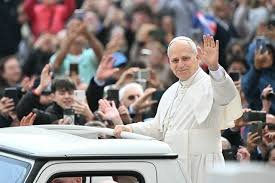
ALGIERS, Algeria (AP) — Pope Leo XIV arrived in Algeria on Monday for a historic first papal visit, using the moment to call for peace and denounce “neocolonial tendencies” in global affairs, even as he faced sharp criticism from U.S. President Donald Trump over his stance on the U.S.-Israeli war with Iran.
 The visit to Algiers marks the beginning of an 11-day tour across four African nations — Algeria, Cameroon, Angola and Equatorial Guinea — taking the first U.S.-born pope deeper into one of the fastest-growing regions of the Catholic Church.
In Algeria, Leo aims to promote Christian-Muslim coexistence in the predominantly Muslim country and to honor St. Augustine, the North African theologian who inspired his Augustinian spirituality.
However, the trip opened against the backdrop of escalating tensions between Leo and Trump. The U.S. president criticized the pope overnight, saying he was not doing a good job and urging him to “stop catering to the Radical Left.”
Speaking en route, Leo defended the Vatican’s calls for peace, saying they are grounded in the Gospel and insisting he does not fear the Trump administration. In his first remarks in Algiers, he linked his appeal for peace to Algeria’s own struggle for independence from France in 1962, a conflict that claimed hundreds of thousands of lives.
“God desires peace for every nation — a peace rooted in justice and dignity, not merely the absence of conflict,” Leo told thousands gathered at the Martyrs’ Memorial.
Later, in talks with President Abdelmadjid Tebboune, Leo praised Algeria’s culture of solidarity and mutual respect, saying it offers an important perspective on global power dynamics.
“Such values are urgently needed today amid ongoing violations of international law and neocolonial tendencies,” he said, without naming specific conflicts, though he has previously referenced wars in Ukraine, Iran and Lebanon.
Despite being a Muslim-majority nation of about 47 million people, Algeria is home to a small Catholic community of roughly 9,000, mostly foreigners. The archbishop of Algiers, Cardinal Jean-Paul Vesco, noted that the famed Our Lady of Africa basilica regularly welcomes Muslim visitors.
“It shows that we can live as brothers and sisters despite our differences,” Vesco said. “That has been the mission of the church here since independence.”
Still, concerns over religious freedom persist. The United States has placed Algeria on a watch list for alleged violations, citing restrictions on proselytizing and the closure of some churches.
“I think it’s good that a pope is visiting Algeria,” said Selma Dénane, a student in Annaba. “But will it change anything? Will Christians be able to openly say who they are without fear?”
Leo’s visit also reflects on Algeria’s violent past. During the 1990s civil war — the so-called “black decade” — around 250,000 people were killed. Among them were 19 Catholic clergy and religious workers, including seven monks from Tibhirine, who were kidnapped and killed in 1996.
On his first day, Leo paid tribute to these martyrs and met with Augustinian nuns continuing their social work in Algiers.
“They gave their lives for God, for the church, and for the Algerian people,” said Sister Lourdes Miguelez.
The 19 were beatified in 2018, marking the first such ceremony in the Muslim world. Their legacy continues to shape Leo’s message, particularly the idea of an “unarmed and disarming peace,” a phrase he has embraced since his election.
The visit is also deeply personal. Leo’s Augustinian order is rooted in the teachings of St. Augustine of Hippo, who was born in present-day Algeria. On Tuesday, the pope is set to visit Annaba — ancient Hippo — where Augustine served as bishop.
Since becoming pope, Leo has frequently cited Augustine, calling himself a “son of St. Augustine” and drawing heavily on his theological legacy.
“The influence of Augustine on Western thought is immense,” said Paul Camacho of the Augustinian Institute at Villanova University. “It extends far beyond the Catholic Church.”
About the Author